
Will the AI Productivity Boom Reach Canadian Workers? What Canada's Economy Is Already Telling Us

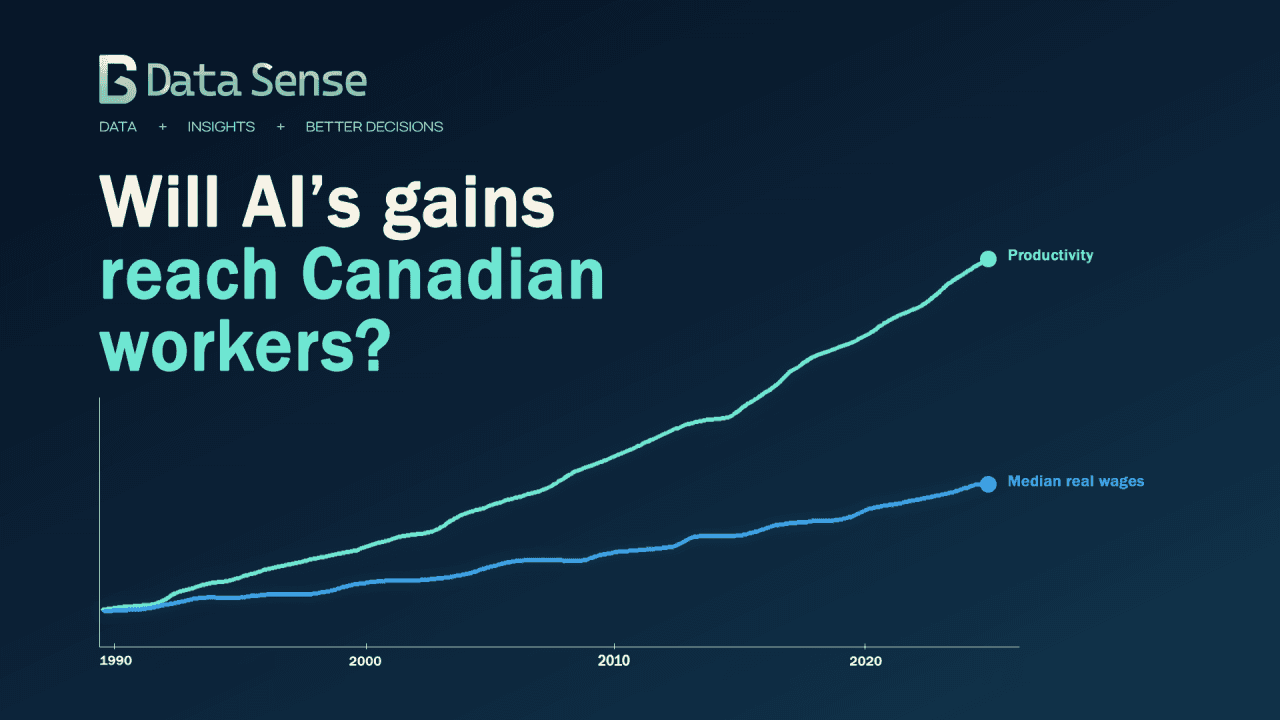
AI promises a productivity boom. But Canada's recent record on median real wages, GDP per capita and wealth distribution shows that productivity gains do not automatically translate into higher living standards.
The disconnect between wages and the cost of living
I recently had a conversation about Canada's job outlook, I mentioned that in Canada right now wages feel stagnant, even when the headlines suggest they are rising.
For many Canadians, the pressure is familiar. Housing remains expensive, grocery bills have increased substantially, and finding a job that offers meaningful financial progression can feel increasingly difficult. Even when employment opportunities exist, it is not always clear that changing jobs will materially improve someone's standard of living.
This is particularly relevant today, given the potential productivity boom we are about to (or being told will come) from AI.
Before we assume AI will raise living standards, it's worth looking at what Canada's economy is already showing us: productivity gains that haven't fully reached workers, real wages that have barely moved, and GDP per capita that has fallen.
The productivity–wage gap: Why AI makes this question more important
The disconnect between economic growth and workers' purchasing power is not a new observation. Canadian economists have studied the relationship between productivity and median wages for decades.
Productivity measures how much output is produced for a given amount of labour input. Increases in labour productivity create the potential for higher real wages, higher profits, lower prices or some combination of the three. The issue then is how those gains are distributed.
A 2021 study by Andrew Sharpe and James Ashwell, published in the International Productivity Monitor, examined the relationship between labour productivity and median real hourly wages in Canada from 1976 to 2019. The chart below shows the gap between the two in each business cycle:

The researchers found that the annual gap between labour productivity growth and median real hourly wage growth averaged 1.36 percentage points between 1976 and 2000. Between 2000 and 2019, that gap narrowed to 0.46 percentage points per year.
The gap narrowed, which shows productivity gains can be shared more broadly. However, the findings still demonstrate that productivity gains were not fully reflected in the real wages of the typical worker.
The researchers attributed the narrowing gap to several factors, including changes in earnings inequality, labour's share of aggregate income and the relative prices of what workers produce compared with what they consume. Behind those factors, they point to stronger bargaining power for workers after 2000, as unemployment fell, unionization declined more slowly and imports' share of the economy fell.
Productivity gains do not automatically translate into equivalent increases in the purchasing power of the typical worker.
That said, the authors show that the share of productivity gains going to the median worker rose from 38% in 2000–2008 to 63% in 2008–2019, and to 73% in 2013–2019.

AI has the potential to reverse that progress if it weakens demand for some kinds of labour, it could also erode the bargaining power that narrowed the gap after 2000. Recent data shows how quickly the split between output and pay can shift.
How will AI impact the productivity wage gap?
In the second quarter of 2026, business labour productivity rose 1.0%, the largest increase since 2020, as output rose while hours worked fell. In the same quarter, corporate incomes rose 9.6% while compensation of employees rose 1.5%. Those gains were driven mainly by mining, oil and gas, wholesale trade and manufacturing rather than AI, but they show how output and profits can outrun the pay of the people producing them.
AI could amplify this problem if it increases the productive capacity of businesses while reducing their demand for labour, or if the resulting gains accrue disproportionately to owners of capital.
That is an economic risk. However, AI can also complement workers, improve their output, create new tasks and generate demand for new products and services. Its effect on wages and employment will depend on which tasks are automated, which new activities emerge, how quickly businesses adopt the technology and how the resulting gains are distributed.
In Canada, adoption of AI is accelerating. Statistics Canada found that 19.2% of Canadian businesses used AI to produce goods or deliver services in the year to spring 2026, triple the share two years earlier, and that AI adopters are 16.8% more productive than non-adopters. By March 2026, just over one in three Canadian workers had used generative AI tools at work in the previous year.
So if AI increases productivity, but doesn't produce a meaningful number of new jobs or opportunities, is the "pain" as it was described at the IMF-WB meetings going to be worthwhile?
IMF Managing Director Kristalina Georgieva said IMF research shows about 40% of jobs globally, and as many as 60% in advanced economies like Canada, will be augmented, downgraded or eliminated by AI, and pointed to an expected shift in income from labour to capital.
At the same meetings, I watched Bank of Canada Governor Tiff Macklem compare AI's effect on jobs to the effect of more open trade. Trade generated global wealth and lifted millions out of poverty, but many people lost their livelihoods as manufacturing moved abroad. In aggregate there is an overall benefit, he said, but there will be winners and losers: "You have to find a way to help the losers." Without a support system, he warned, there will be a backlash.
There are already signs of unease, even though the numbers show little impact so far, largely because an economy can become more productive without the resulting gains being distributed evenly between workers and owners of capital. If productivity rises while median real wages grow more slowly, the typical worker receives a smaller proportion of the potential benefit from economic progress.
The historical productivity–wage gap gives us a reason to examine these outcomes carefully. If AI generates another wave of productivity growth, we should not assume that the median worker's purchasing power will automatically rise at the same rate.
Sources:
- Sharpe and Ashwell (2021), The Evolution of the Productivity-Median Wage Gap in Canada, 1976–2019
- Statistics Canada, Labour productivity, second quarter 2026
- Statistics Canada, AI adoption and productivity in Canadian firms (2026)
What we're already observing: real wages have barely moved
To understand this disconnect, we need to distinguish between nominal and real wage growth.
Nominal wage growth measures the increase in wages before adjusting for inflation. Real wage growth measures the change in purchasing power after accounting for changes in prices.
If wages increase by 3% while consumer prices rise by 4%, real wages have fallen by approximately 1%. Workers receive more dollars, but those dollars buy less.
In August 2026, Statistics Canada reported that average hourly wages rose 2.0% year over year, the slowest pace since 2017 outside the pandemic, while consumer prices rose 3.0%. The average worker's real hourly wage fell by roughly 1%. For employees in the bottom 25% of the wage distribution, wages rose just 1.1%.

Headlines often cite nominal wage growth as an indicator of economic progress. It tells us what employers are paying in dollar terms, but it does not tell us whether workers are becoming better off.
Therefore it's necessary to examine whether wage growth is keeping pace with the cost of living, and whether economic growth is translating into higher purchasing power for the typical Canadian.
Why median real wages, not averages, will show whether AI is helping
Average wages are useful, but they can obscure what is happening across the wage distribution.
A mean can be pulled upward by rapid earnings growth among high earners. It can also be affected by changes in the composition of employment, such as the loss or return of lower-paid jobs. The result can be an increase in average wages even when the typical worker experiences much smaller gains.
The median provides a complementary view to the mean. It represents the midpoint of the wage distribution where half of employees earn more, and half earn less.
Statistics Canada's analysis of wages from 1981 to 2024 uses median real hourly wages to examine long-term changes in purchasing power. Its findings show that between May 1981 and May 2024, median real hourly wages across all jobs increased by 20%. Most of that growth occurred after 2003.
That is a 20% increase over 43 years, equivalent to an annualized growth rate of approximately 0.4%. The longer-term trend is important, but the more recent figures are particularly relevant to the current cost-of-living debate.
Statistics Canada's median real hourly wage index, with 1981 set to 100, stood at 119.6 in 2021. It fell to 116.0 in 2022, before recovering to 120.3 in 2024. In other words, median real hourly wages were only 0.6% above their 2021 level by 2024.
The index captures the inflation-adjusted hourly wage, not the full cost of maintaining a household. It does not include differences in housing costs, taxes, working hours or household composition. Nevertheless, it provides a useful measure of how little the median employee's real hourly wage changed over this period.
The data shows that after the post-pandemic inflation shock, the purchasing power of the median hourly wage had barely improved relative to 2021.
Statistics Canada's long-run median wage study runs to 2024, but the 2026 monthly data points in the same direction, showing that wage growth has slowed sharply, and it has slowed most for lower-paid workers.
This is also why the median will matter if AI delivers on its promise. If AI’s gains flow mainly to high earners and owners of capital, average wages could rise while the typical worker sees little change. Headlines may point to stronger average wage growth as evidence that AI is paying off, but the median will show whether lower- and middle-income workers are sharing in it.
Sources:
- Statistics Canada, Wages in Canada, 1981 to 2024
- Statistics Canada, Labour Force Survey, August 2026
GDP growth does not necessarily mean Canadians are better off, and AI could widen that gap
To examine AI's full effect on the productivity–wage gap, the median real wage is only half the picture. We should also look at real GDP per capita, which adjusts economic output for inflation and population growth. Together, they show whether AI-driven productivity gains are raising output per person, and whether the typical worker is sharing in them.
Total GDP can rise because the economy is producing more, because the population is growing, or through a combination of both. When population grows faster than real output, GDP per capita falls.
Statistics Canada's national accounts show that real GDP per capita declined by 1.3% in 2023 and a further 1.4% in 2024. These consecutive declines indicate that average inflation-adjusted economic output per person fell over those two years.
The weakness carried into 2025. By the first quarter of 2026, real GDP per capita was still about 1.4% below its 2022 peak, even though total real GDP had grown by more than 5% over the same period. Output per person only began to recover in the second quarter of 2026, when real GDP per capita rose 1.0%, helped by Canada's population declining for a third consecutive quarter.
Why did output per person fall while the economy grew?
The Bank of Canada's 2026 assessment of potential output estimates that labour productivity was about 6% below its pre-pandemic trend by early 2026, and that the rapid rise in non-permanent residents since 2022 accounts for roughly 70% of that decline.
The labour force grew faster than businesses invested in equipment and technology, so capital per worker fell, and many newcomers were younger and earned less than established workers. As population growth slows, the Bank expects productivity to recover toward its trend.
When GDP per capita declines while housing and other essential expenses remain high, it becomes harder to argue that aggregate economic growth is translating into improving material living standards for the population as a whole.
The lesson is that total output and output per person can move in opposite directions. Yet, AI could produce a different kind of divergence, one where output per person rising while the typical worker's wage falls behind.
How large could AI's productivity boost be in Canada?
The same Bank of Canada assessment assumes AI will add about 0.2 percentage points a year to productivity growth, or roughly 2% over a decade, an estimate it describes as conservative.
Part of the reason is attributed to historical technological progress. During the spread of computers and the internet in the early to mid-2000s, Canada's productivity gains lagged well behind those of the United States.
Firm-level studies reviewed by Bank of Canada staff find productivity gains of 15–60% where AI is used, but these have yet to appear in national statistics because adoption takes time and businesses need to reorganize around the technology.
What those gains mean for workers depends on how AI is used. A July 2026 Bank of Canada staff paper distinguishes between augmentation, where AI makes workers more productive in their existing tasks, and automation, where AI takes over tasks from workers entirely.
Consider a scenario in which AI allows businesses to produce the same output with fewer employees, or to increase output without proportionately increasing their workforce. Productivity and profits could rise even if employment growth slows. If the gains accrue primarily to shareholders and other owners of capital, the economy could become more productive without delivering comparable gains in median real wages.
In that scenario, real GDP per capita could rise while median real wage growth stagnates or turns negative. The economy would be producing more per person, but the purchasing power of the typical worker would not necessarily improve.
Canadian firms' own expectations point to some pressure on hiring. In a recent Bank of Canada survey, 18% of firms said they expect to hire fewer staff over the next three years because of AI, compared with 9% that expect to hire more. The Bank's 2026 assessment also flags the risk that workers in AI-exposed occupations could be displaced and struggle to find new jobs.
This phenomenon is not new. Economic research on automation has examined how replacing labour tasks with technology can increase productivity while reducing demand for certain types of work. AI extends these impacts into a wider range of cognitive and professional tasks.
A 2024 paper in Oxford Open Economics by Daron Acemoglu and Pascual Restrepo discusses both sides of this process and shows automation can increase productivity, but it can also displace workers from tasks and weaken their share of the economic gains. In separate 2024 work, Acemoglu estimates AI's economy-wide productivity gains at under 1% over ten years, well below more optimistic forecasts.
The IMF has also examined the potential distributional effects of generative AI. Its 2024 staff discussion note finds that AI could increase income and wealth inequality if it disproportionately complements higher-income workers and increases returns to capital. However, sufficiently large productivity gains could also raise incomes across much of the distribution.
These findings challenge the assumption that productivity growth alone is enough to ensure broad-based improvements in living standards.
Sources:
- Statistics Canada, Gross domestic product, income and expenditure, second quarter 2026
- Statistics Canada, Gross domestic product, income and expenditure, fourth quarter 2024
- C.D. Howe Institute: The Canadian Economy Was Struggling Long Before GDP Growth Turned Negative (2026)
- Bank of Canada: Potential Output in Canada, 2026 Assessment
- Bank of Canada: AI Paradox: Promise vs. Reality (2026)
- Bank of Canada: Monetary Policy in an AI-Driven Two-Speed Economy (2026)
- Bank of Canada: Survey Evidence on Firm AI Adoption and its Implications (2026)
- Acemoglu and Restrepo: A Task-Based Approach to Inequality, Oxford Open Economics (2024)
- Acemoglu: The Simple Macroeconomics of AI, NBER Working Paper 32487 (2024)
- IMF: Gen-AI, Artificial Intelligence and the Future of Work (2024)
What early evidence tells us about AI and employment in Canada
If productivity growth alone does not guarantee better living standards, then who benefiting from AI? Much of the research above describes what could happen. It’s important to separate those potential effects from what we can already observe in Canada’s labour market.
Statistics Canada's January 2026 study, Canadian employment trends in the era of generative artificial intelligence: Early evidence, examined employment patterns between November 2022 and December 2025.
The study found that employment generally grew across occupations with different levels of potential AI exposure and complementarity. However, employment growth was weaker for younger workers and those with less education. Coding-intensive occupations also showed a divergence by age. Employment growth among coding professionals aged 30 to 49 was stronger than among those younger than 30, whose numbers stagnated.

These findings do not establish that AI caused the weaker employment outcomes for younger workers. Nor do they demonstrate that AI has already caused widespread job displacement across Canada. They do, however, show why aggregate employment figures may be insufficient to understand how technological change affects different groups.
Young workers are also facing a soft labour market more broadly. The youth unemployment rate was 12.9% in August 2026, lower than a year earlier but still well above the pre-pandemic average of 10.8%. At the same time, Statistics Canada finds that almost 90% of firms that adopted AI reported no change in their employment levels, so the displacement, so far, appears to be showing up in hiring rather than layoffs.
Newer Canadian research points in the same direction. A Bank of Canada staff analysis published in August 2026 found that the gap in unemployment risk between workers in highly AI-exposed occupations and those with little exposure widened to 2.8 percentage points in 2025, up from an average of 1.9 points between 2015 and 2019.
The difference came mainly from exposed workers taking longer to find a new job, not from more layoffs. The Bank also found that younger workers are more concentrated in moderately and highly exposed occupations, such as customer service and sales support. Like Statistics Canada, the authors caution that these are early signals and do not show that AI alone caused the gap.

The Bank of Canada's latest surveys, released on October 19, 2026, add to this picture. In its third-quarter Business Outlook Survey, most firms planned to keep headcounts unchanged, and several said automation and other efficiency gains would let them meet higher sales without adding workers.
Firms across sectors reported plans to invest in AI tools embedded in software, machinery and automation systems. The Bank's companion consumer survey found that about 40% of workers now use AI at work, but labour market perceptions worsened among workers in sectors where AI poses a higher risk of task replacement. This is the exact scenario we described earlier where output is growing without a matching increase in hiring.
The U.S. evidence is sharper. A 2026 U.S. Census Bureau working paper found that hiring of 22- to 24-year-olds in the most AI-exposed industries dropped 9% after ChatGPT's release, contributing to a 12% decline in early-career employment in those industries through early 2025, while employment in less exposed industries remained stable.
Not everyone reads the evidence the same way. In May 2026, Bank of Canada Deputy Governor Michelle Alexopoulos said the evidence does not yet point to widespread worker displacement from AI, and the OECD's 2026 Employment Outlook concluded that evidence of AI's impact on younger workers is still limited.
But the pattern emerging across these studies consistently tells us that where AI is showing up in the labour market, it is showing up first in hiring, and first for young workers.
The longer-term effects will depend on how AI is deployed. Some businesses may use it to augment existing employees, allowing them to produce more. Others may reduce hiring, consolidate roles or automate tasks previously performed by junior employees.
New industries and occupations may emerge, but the workers displaced by technological change will not necessarily be the ones best positioned to fill them. Those who do move into new roles may do so at lower pay, which wouldn't show up in employment figures but would show up in median real wages.
This is particularly important for early-career workers. If businesses automate tasks traditionally used to train junior employees, the effects could extend beyond immediate job losses to the availability of future career pathways.
AI's labour-market effects remain uncertain, with meaningful differences emerging across occupations and demographic groups. To examine the effect, employment must be monitored alongside wages, hours worked, job quality, hiring rates and progression into higher-skilled roles.
Sources:
- Statistics Canada: Canadian employment trends in the era of generative artificial intelligence, January 2026
- Bank of Canada, AI exposure and labour market outcomes (August 2026)
- U.S. Census Bureau, You're (not) Hired: Artificial Intelligence and Early Career Hiring (2026)
- Reuters via Kitco, Bank of Canada on AI and jobs (May 2026)
- OECD Employment Outlook 2026; Statistics Canada, Use of generative AI tools among Canadian workers, March 2026.
- Bank of Canada, Business Outlook Survey, third quarter 2026
- Bank of Canada, Canadian Survey of Consumer Expectations, third quarter 2026
Income growth, wealth accumulation and who benefits from AI
So far, the evidence has focused on workers and their wages, their jobs and their chances of being hired. But if AI shifts income from labour to capital, as the IMF expects, the other half of the equation is who owns that capital.
Wages are only one source of economic resources. Households can also receive investment income, business income, pension income and capital gains, while accumulating wealth through property and financial assets.
A household that owns a home and a substantial investment portfolio may benefit from rising asset values even when its wage income grows more slowly. A household that rents and has little invested capital may receive no comparable benefit from those same increases in asset prices.
We already see this disparity in middle aged Canadians who do not own homes. Further evidence from Statistics Canada's household economic accounts shows the scale of the difference.
At the end of 2025, the wealthiest 20% of Canadian households held 65.7% of total household net worth. The bottom 40% held just 3.0%.
The average net worth of a household in the wealthiest 20% was approximately $3.5 million, compared with $81,650 among households in the bottom 40%. To put it differently, the average household in the top 20% has roughly 43 times the net worth of the average household in the bottom 40%.
These figures describe the distribution of wealth, not the distribution of wages. They should not be interpreted as evidence that every wealthy household experienced gains while every lower-wealth household lost ground. They do, however, demonstrate how differently households are positioned to benefit from increases in asset values.
Statistics Canada also reported that household net worth rose 5.3% over 2025, entirely due to a 9.9% gain in financial assets, mainly from equity markets. The wealthiest households grew their net worth fastest (+6.0%), and the wealth gap between the top 20% and the bottom 40% widened over the year.
For households with significant financial assets, these gains can increase net worth without requiring additional employment income. For households without assets, the same wealth effect is largely unavailable.
AI has the potential to widen this gap even further
If AI increases the returns to businesses that own the technology, computing infrastructure, intellectual property and other productive assets, the benefits may accrue disproportionately to their owners. Households with substantial financial assets could benefit through higher profits and investment returns, while households relying primarily on wages could see more limited gains if labour demand and wage growth fail to keep pace.
The IMF's 2024 analysis identifies this as a potential channel through which AI could increase wealth inequality. Stronger productivity growth can also increase labour demand and incomes. The variables are the scale of the productivity gains, the extent of labour displacement, the complementarity between AI and workers, and the distribution of capital ownership.
This is why the distribution of economic gains deserves attention alongside the headline productivity figures. An economy can generate substantial additional output while leaving many households with little improvement in their purchasing power or financial security.
Source:
- Statistics Canada, Distributions of household economic accounts, fourth quarter 2025.
- IMF: Gen-AI, Artificial Intelligence and the Future of Work (2024)
What Canada's economy is already telling us about AI
Taken together, these indicators describe different aspects of the same economic question. On its own, any one of them can make AI look like a clear win or a clear loss. In combination, they give a more complete, if more complicated, picture of how AI is actually affecting Canadians.
Median real wages show whether the purchasing power of the typical employee is increasing. Productivity growth measures the economy's capacity to produce more output per hour worked. Real GDP per capita indicates whether output per person is growing. Household income and wealth distributions show how financial gains are spread across the population.
None of these indicators is sufficient on its own. But taken together, they provide a more informative assessment of economic progress than nominal wage growth or aggregate GDP alone.
The Canadian evidence points to four important findings
First, median real hourly wages grew by only 20% between 1981 and 2024, with most of that increase occurring after 2003. Between 2021 and 2024, median real hourly wages increased by just 0.6%. In August 2026, average hourly wages rose 2.0% year over year while prices rose 3.0%.
Second, academic research has documented a persistent gap between productivity growth and median real wage growth. The gap narrowed after 2000, but productivity gains were still not fully reflected in the wages of the typical worker.
Third, economic resources remain highly concentrated. At the end of 2025, the wealthiest fifth of Canadian households held almost two-thirds of household net worth, while the bottom 40% held just 3.0%.
Fourth, real GDP per capita fell from its 2022 peak until early 2026, and early evidence since generative AI arrived shows weaker employment growth for younger and less-educated workers. In October 2026, firms told the Bank of Canada they expect automation and efficiency gains to let them meet higher sales without adding workers.
These findings do not mean that every Canadian's living standard has stagnated, or that productivity gains have benefited only asset owners. They show that economic growth, wage growth and wealth accumulation are different processes, and that aggregate growth does not guarantee broad-based improvements in purchasing power.
These are the conditions AI is arriving into. If the existing gaps persist, an AI productivity boom could widen them rather than close them.
Conclusion: AI productivity is only part of the equation
Canada's economic performance is often discussed in terms of GDP growth, employment and rising nominal wages. As AI becomes more widely adopted, productivity growth will likely feature even more prominently in assessments of economic progress.
But productivity is a measure of what an economy can produce. It does not, by itself, tell us how the resulting gains are distributed.
If median real wages barely increase, GDP per capita falls and wealth remains concentrated among households that already own substantial assets, there is a legitimate question about how effectively economic growth is improving living standards.
AI could help address Canada's longstanding productivity challenges. It could enable businesses to produce more, improve services, create new products and support higher incomes. But it could also reduce demand for certain types of labour, weaken entry-level opportunities and increase returns to capital relative to labour.
The outcome will depend on how the technology is adopted and how its benefits are distributed.
If AI enables businesses to generate more output with fewer workers, the resulting productivity gains should not automatically be treated as evidence that living standards are improving for the population as a whole.
We need to examine whether those gains translate into higher median real wages, broader employment opportunities, lower consumer costs and greater economic security.
The real test of AI-driven productivity growth is whether it improves living standards beyond the businesses and investors who capture the initial gains.
For policymakers, employers and investors, that means looking beyond productivity and aggregate GDP. Median real wages, labour's share of income, employment opportunities and wealth distribution will be essential indicators of whether technological progress is producing broad-based economic gains.
The objective should not be growth for its own sake. It should be an economy in which productivity gains translate into sustainable improvements in the living standards of the people who contribute to that growth.
Further reading and data
- Statistics Canada: Labour Force Survey, August 2026
- Statistics Canada: Wages in Canada, 1981 to 2024
- Sharpe and Ashwell (2021): The Evolution of the Productivity-Median Wage Gap in Canada, 1976–2019
- Statistics Canada: Labour productivity, hourly compensation and unit labour cost, second quarter 2026
- Statistics Canada: Gross domestic product, income and expenditure, second quarter 2026
- Statistics Canada: Canadian employment trends in the era of generative artificial intelligence (2026)
- Statistics Canada: Artificial intelligence adoption and productivity in Canadian firms (2026)
- Statistics Canada: Distributions of household economic accounts, fourth quarter 2025
- IMF: Gen-AI, Artificial Intelligence and the Future of Work (2024)
Looking to Implement This Architecture in Production?
We partner with financial institutions, investment funds, regulatory bodies, and operating teams to design and deliver automated reporting pipelines, executive dashboards, and governed AI infrastructure.